

Key Takeaways
- Self-criticism often starts as a protective mechanism learned in childhood — but it outlives its usefulness.
- Chronic negative self-talk activates the brain’s threat system the same way external danger does, keeping you anxious and stuck.
- Replacing self-criticism with self-compassion does not mean lowering your standards — research shows it actually improves motivation and resilience.
- You can retrain your inner voice using practical, evidence-backed tools — starting today.
Introduction: The Voice That Never Clocks Out
Picture this. You finish a presentation at work. Your manager nods, your colleagues applaud. You walk back to your desk and the first thought in your head is: “I stumbled over that second slide. Everyone noticed. Why can’t I just get it right?”
The world gave you a round of applause. Your own mind handed you a report card full of red marks.
If that scene feels familiar, you are not broken. You are not uniquely flawed. You are, however, caught in one of the most common psychological loops that quietly exhausts millions of people — relentless self-criticism.
Being hard on yourself feels, on the surface, like responsibility. Like ambition. Like caring enough to hold yourself accountable. But beneath that story lives something far less noble: a threat-detection system misfiring at your own reflection.
This article is not about teaching you to ignore your mistakes or skip accountability. It is about understanding why that inner voice is so savage, what it is actually costing you, and how to build a healthier relationship with the person you spend every waking second with — yourself.
“You can make a thousand errors and still not be an error yourself. The critic inside your head is not a truth-teller. It is a habit — and habits can be changed.”
Where Does Self-Criticism Come From?
Childhood: The Original Classroom
Most harsh inner voices were not born. They were taught.
A parent who praised only A grades. A coach who drilled the team with “not good enough” as a motivational tool. A classroom where mistakes earned public humiliation. Children absorb these environments and, to manage the unpredictability of adult approval, internalize the judgment. They become their own disciplinarians before anyone external gets the chance.
Dr. Kristin Neff, a leading researcher at the University of Texas at Austin, describes this as turning the critical lens inward as a survival strategy. If you judged yourself before others could, at least you had some illusion of control.
Perfectionism as Armor
For many people, self-criticism wears the costume of high standards. Arjun, a software engineer in his early thirties, came to therapy convinced his brutal self-evaluation was why he kept getting promoted. “If I stop being hard on myself,” he told his therapist, “I’ll get lazy. I’ll coast.”
What his therapist helped him see was different: he was not successful because of the harsh voice. He was successful despite the crippling anxiety it produced every time he had to submit code for review.
Perfectionism, it turns out, is less about excellence and more about avoiding shame. The two are not the same thing.
Cultural and Social Conditioning
Culture shapes the inner critic, too. Collectivist societies often instill a strong sense of shame around failure because individual errors reflect on the family unit. In highly competitive academic or corporate environments, self-flagellation becomes a socially rewarded performance — a signal to others that you care, that you are serious, that you are not arrogant.
The trouble is the audience eventually goes home. The performance continues in your head at 2 a.m.
The Brain Science Behind Your Inner Bully
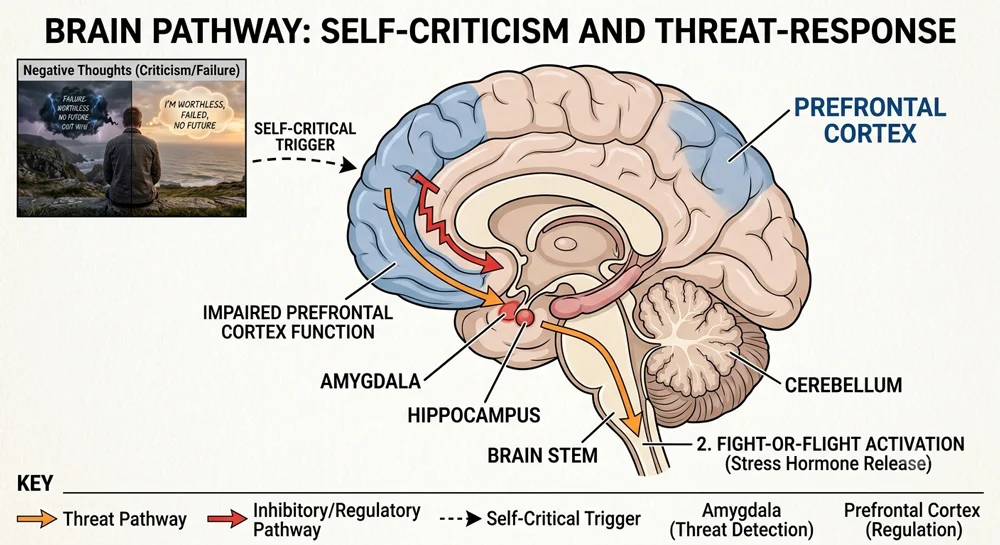
Your brain cannot reliably distinguish between a tiger charging at you and a memory of something embarrassing you said at dinner five years ago. Both can activate the amygdala, the brain’s alarm system, flooding your body with cortisol and adrenaline.
Self-criticism triggers exactly this threat response. Studies using neuroimaging have shown that people with high levels of self-critical thinking display elevated amygdala activity and reduced activity in the prefrontal cortex — the region responsible for rational perspective and emotional regulation. You are, in a very literal sense, scaring yourself.
Over time, chronic self-criticism keeps the nervous system in a low-grade state of alert. This produces outcomes that feel like personality traits but are actually physiological responses: difficulty concentrating, procrastination, avoidance, and a hair-trigger for shame.
Here is the irony: the very tool you believe is sharpening your performance is degrading the neural systems you need to actually perform well.
When Being Hard on Yourself Backfires
What You Believe Self-Criticism Does | What Research Shows It Actually Does |
Motivates you to improve | Triggers avoidance and procrastination |
Keeps you humble | Increases anxiety and depression risk |
Sharpens focus | Narrows cognitive flexibility |
Signals high standards | Often masks fear of failure, not ambition |
Prevents future mistakes | Biases attention toward past errors, not solutions |
When you are hard on yourself after a mistake, your nervous system registers social threat. The emotional fallout from self-attack can actually impair the learning process that should follow a failure. Your brain gets busy managing the emotional wound rather than extracting the lesson from the experience.
Priya, a graphic designer, described it perfectly: “Every time a client rejected a design, I spent three days telling myself I was talentless. By the time I felt okay again, I had no energy left to actually figure out why the design didn’t land.”
The self-criticism ate the lesson.
The Self-Compassion Shift: What It Actually Means
Self-compassion is one of the most misunderstood psychological concepts in popular culture. People hear “be kind to yourself” and picture bubble baths, lowered standards, and unconditional self-congratulation.
That is not what it means.
Dr. Neff defines self-compassion through three components:
- Self-kindness — treating yourself with the warmth you would offer a close friend who is struggling, rather than harsh judgment.
- Common humanity — recognizing that suffering, failure, and inadequacy are universal human experiences, not personal defects.
- Mindfulness — observing your painful thoughts and feelings with balance, neither suppressing them nor amplifying them.
Notice what is not on that list: excusing bad behavior, avoiding accountability, or pretending failure did not happen.
Self-compassion research consistently shows that people who score higher on self-compassion scales take more personal responsibility for mistakes — not less — because they are not terrified of facing them. When the emotional penalty for failure is reduced, honest self-assessment becomes possible.
A Practical Framework: From Harsh Judge to Fair Witness
Step 1: Name the Voice Without Becoming It
The next time the inner critic fires up, try this. Instead of thinking “I am so stupid,” catch yourself and reframe: “There is the critic again, telling me I’m stupid.” Naming the voice creates distance. You are observing it, not obeying it.
Psychologists call this cognitive defusion — a core technique in Acceptance and Commitment Therapy (ACT).
Step 2: Run the “Best Friend Test”
Ask yourself: if my closest friend told me they had just made this exact mistake, what would I say to them?
Write it down. Then re-read what you wrote. The gap between how you would respond to your friend and how you are responding to yourself is the gap you are working to close.
Step 3: Find the Fear Beneath the Criticism
Self-criticism almost always has a fear underneath it. “I am so disorganized” usually translates to “I am afraid people will see me as incompetent.” Identifying the underlying fear shifts your energy from punishment to problem-solving.
Ask: what am I actually afraid will happen if this mistake defines me?
Step 4: Set the Standard, Not the Sentence
Accountability without cruelty looks like this:
Harsh Self-Criticism | Accountable Self-Compassion |
“I completely ruined that.” | “That did not go as I intended. What can I do differently?” |
“I always mess this up.” | “I have struggled with this before. What support do I need?” |
“I am so behind. I am a failure.” | “I am behind. Let me figure out the most important next step.” |
The second column is not softer on your goals. It is sharper on your path.
Step 5: Build a Daily Reset Ritual
Brief, consistent practices disrupt the automatic nature of self-critical thinking. Even five minutes of journaling with the prompt “What did I handle reasonably well today?” begins to retrain attention away from the exclusive focus on shortcomings.
This is not toxic positivity. It is deliberate attentional balance.
FAQs
What is self-criticism, exactly?
Self-criticism is the internal habit of evaluating yourself negatively, harshly, or uncharitably in response to perceived failures, flaws, or mistakes. It is different from honest self-reflection because it tends to be absolute (“I always fail”), emotionally punishing, and resistant to evidence that contradicts the negative narrative. Where healthy self-reflection asks “what went wrong and how do I improve?”, self-criticism typically asks “what does this say about how defective I am?”
Is being hard on yourself a sign of high standards?
Not necessarily. Research suggests that while self-criticism often coexists with high ambition, it is typically driven by a fear of shame rather than a genuine desire for growth. High standards and self-compassion are not opposites. Studies by Dr. Kristin Neff and colleagues found that self-compassionate individuals maintain equally high personal standards but respond to failures with curiosity and problem-solving rather than self-attack. The difference lies in motivation: growth versus avoidance of humiliation.
Can self-criticism cause anxiety and depression?
Yes. Chronic negative self-talk is strongly associated with both anxiety and depression. The inner critic activates the brain’s threat-response system, which keeps the body in a sustained low-grade stress state. Over time, this dysregulates mood, sleep, and motivation. Clinical research consistently identifies self-criticism as a transdiagnostic risk factor — meaning it appears as a common underlying feature across multiple mental health conditions, not just depression. If your inner critic is significantly impacting daily functioning, speaking with a licensed therapist is a practical and worthwhile step.
How do I stop being so hard on myself without losing my drive?
Start by separating the goal from the punishment. Your drive to achieve does not come from the self-critical voice — it comes from your values and what genuinely matters to you. The self-critical voice is just one (often counterproductive) delivery mechanism for that drive. Replacing punishment with curiosity — “what can I learn here?” instead of “how did I let this happen?” — tends to protect motivation while removing the emotional cost. Small practices like the “best friend test” and cognitive defusion help build this habit over time.
Conclusion
You did not invent your inner critic. It was assembled from years of feedback, fear, and the very human need to belong and be seen as capable. Understanding that origin does not excuse the damage it does — but it does change the story. The voice that tears you down was never really yours to begin with.
The path forward is not to silence self-evaluation or pretend your mistakes do not matter. It is to become a fair witness to yourself: honest, grounded, and motivated by growth rather than terror. The same rigor you apply to your work, your relationships, your goals — you are allowed to apply it to the way you talk to yourself.
Start with one conversation. The next time the critic shows up, pause before you accept its verdict. Ask whose voice that really is. Then ask what a genuinely good mentor — someone who cared about both your growth and your wellbeing — would say instead.
That voice exists in you too. It just needs more practice.