

Key Takeaways
- Emotions produce measurable, consistent physical sensations across the body, and these patterns are remarkably similar across different cultures.
- Your body often registers an emotional response before your conscious mind catches up, which is why physical signs of emotions can feel like they “come out of nowhere.”
- Chronic suppression of somatic feelings does not eliminate them. It drives them deeper into the body, where they can manifest as tension, fatigue, or illness.
- Learning to read your body’s signals is one of the most evidence-backed paths to emotional intelligence and mental wellbeing.
Introduction
Picture this: you get an email from your manager that says, “Can we talk? It’s urgent.” Before you have read a single word of the follow-up, your stomach has already dropped. Your shoulders have already climbed toward your ears. Your breathing has gone shallow.
You did not decide to feel any of that. Your body just did it.
This is not anxiety playing tricks on you. It is your nervous system doing exactly what it was built to do: scanning for threat, cataloguing it, and preparing you to respond, all before your rational brain has had a chance to say, “I’m sure it’s fine.”
The relationship between emotions and the body is not metaphorical. It is anatomical. Decades of neuroscience, somatic psychology, and cross-cultural research have confirmed what ancient traditions have long insisted: feelings are not just mental events. They are whole-body experiences, encoded in muscle, gut, breath, and heartbeat.
Yet most of us were taught the opposite. We learned to describe emotions as things happening in our heads, to be managed through thinking. We learned to push physical discomfort away rather than read it as information.
That gap between what the body knows and what the mind acknowledges is where enormous suffering lives. And closing it begins with one simple act: paying attention.
“The body is not an instrument of the mind. It is the mind made flesh. Every thought you think, every emotion you feel, has already happened somewhere beneath your skin before it reaches your awareness.” — Paraphrased from somatic psychology tradition
The Science Behind Body Sensations and Emotions
Your Brain Does Not Lead. Your Body Does.
The neuroscientist Antonio Damasio spent years studying patients with damage to the ventromedial prefrontal cortex, the region of the brain that integrates emotional signals from the body. These patients retained normal intelligence and logical reasoning. Yet they became incapable of making sound decisions.
Why? Because decision-making, Damasio concluded, depends on somatic markers: gut feelings, physical hunches, the faint unease that tells you something is off. Without bodily sensation feeding back to the brain, thinking loses its anchor.
This finding upended the old model that positioned emotions as irrational noise interfering with clean, rational thought. The body is not noise. It is signal.
The Polyvagal Connection
Stephen Porges’ Polyvagal Theory adds another layer. The vagus nerve, a long, branching structure running from the brainstem down through the heart, lungs, and gut, is constantly transmitting information in both directions. About 80% of the traffic on that nerve runs upward, from body to brain, not the other way around.
Your gut really does send messages to your head. Your heart literally informs your perception. The phrase “listen to your body” is less self-help slogan and more anatomical instruction.
What Happens Chemically
When you encounter something emotionally charged, your hypothalamus triggers a cascade: adrenaline floods the system, cortisol follows, your heart rate climbs, blood redirects toward large muscle groups, and digestion slows. This is the classic fight-or-flight sequence. But emotions like grief, love, or shame produce their own distinct cocktails of neuropeptides and hormones, each leaving a different fingerprint across different tissues in the body.
Mapping Where Emotions Are Felt in the Body
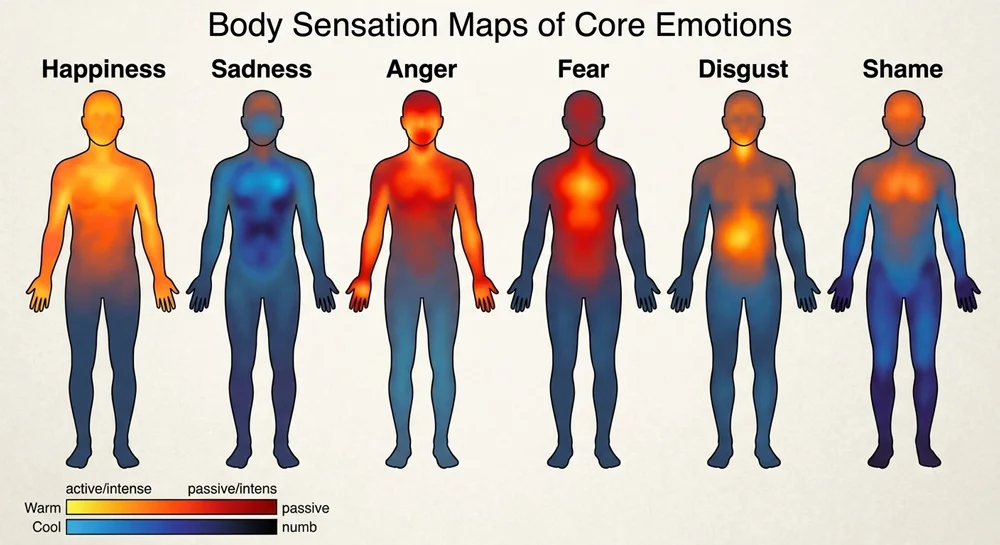
In a landmark study, Finnish researchers asked over 700 participants from Western Europe and East Asia to colour in body silhouettes in response to emotional words, stories, and films. The results were striking: the maps were consistent across cultures, suggesting these physical signatures are not just learned but are rooted in our shared biology.
Here is how the major emotions tend to map:
Emotion | Primary Body Zones | Common Sensations |
Anger | Upper chest, arms, jaw, face | Heat, tension, pressure, clenching |
Fear | Chest, throat, abdomen, legs | Tightness, trembling, hollow feeling |
Happiness | Chest, face, entire upper body | Warmth, lightness, expansiveness |
Sadness | Chest, throat, eyes | Heaviness, constriction, aching |
Love | Chest, abdomen, face | Warmth, fullness, tingling |
Shame | Face, chest, stomach | Flushing, sinking, shrinking |
Disgust | Throat, stomach | Nausea, tightening, withdrawal |
Anxiety | Chest, stomach, shoulders | Flutter, heaviness, held breath |
These are starting points, not rigid rules. Your personal history, nervous system patterns, and cultural context will shape exactly where and how you feel things. But the general architecture is surprisingly consistent across human beings.
Why Physical Signs of Emotions Get Ignored
Awareness of somatic feelings is not automatic. Most of us have spent years, sometimes decades, training ourselves not to feel.
Consider how children are often taught to manage emotions. “Stop crying.” “Calm down.” “You’re overreacting.” These instructions do not teach emotional processing. They teach emotional suppression, specifically the suppression of the body’s natural response. Over time, that suppression becomes so habitual it stops feeling like a choice. The body tenses, and we do not notice. The stomach churns, and we call it indigestion. The shoulders ache with unexpressed grief, and we book a massage.
There is also a cultural dimension. Many professional environments tacitly reward people who appear not to be affected by things. Showing physical signs of emotions at work is often coded as weakness, especially for men and for people in leadership roles. So we develop elaborate systems for keeping the body quiet in public, and eventually we lose the thread of what it’s actually telling us in private.
How Suppressed Emotions Show Up Somatically
The body does not forget what the mind refuses to feel.
Bessel van der Kolk, psychiatrist and trauma researcher, documented this exhaustively in his clinical work. Patients who had experienced trauma and suppressed the associated emotions consistently showed up with physical complaints: chronic pain, autoimmune dysfunction, gastrointestinal disorders, or an inexplicable sense of physical wrongness they struggled to name. The body had stored what the mind had denied.
This is not to say that every backache is emotional or that medical symptoms should be dismissed as “just stress.” The body is a complex system with many causes for any given symptom. But the research is clear: there is a strong, well-established relationship between emotional suppression and physical health outcomes.
Some of the most common somatic expressions of suppressed emotions include:
- Chronic neck and shoulder tension (often associated with carrying unexpressed responsibility, anxiety, or anger)
- Jaw clenching and TMJ issues (frequently linked to suppressed anger or things left unsaid)
- Tight hips and lower back pain (sometimes connected to unprocessed fear or instability)
- Digestive disturbance (the gut is exquisitely sensitive to emotional states via the gut-brain axis)
- Fatigue that does not resolve with rest (a common signal of unprocessed grief or prolonged emotional labour)
Listening to Your Body: A Practical Framework
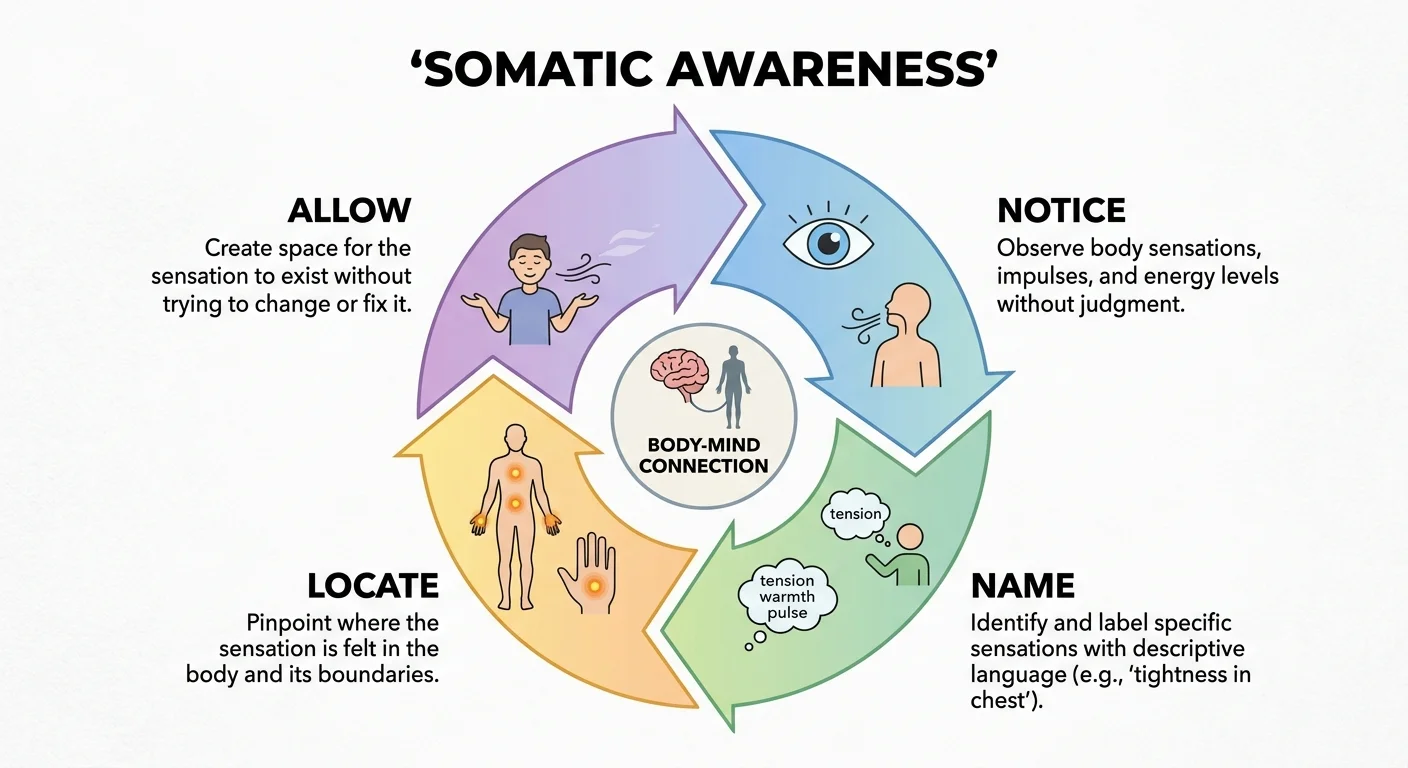
Developing what somatic therapists call interoceptive awareness, the ability to sense and read your body’s internal signals, is a skill. Like any skill, it improves with practice and degrades with neglect.
Here is a simple framework to begin:
Step 1: Pause and Notice
When you experience any shift in mood or energy, stop what you are doing for 30 seconds. Set the phone down. Do not reach for an explanation yet. Just ask: What is happening in my body right now?
Step 2: Locate the Sensation
Move your attention through your body methodically. Start at the top of your head. Work down through your face, jaw, throat, chest, abdomen, hips, legs. Where do you notice something? It might be warmth, tightness, numbness, vibration, or weight.
Step 3: Describe, Do Not Judge
Use neutral, descriptive language. “There is a tight band across my chest” is more useful than “I’m anxious again.” The description keeps you in contact with the physical experience rather than launching you into a story about it.
Step 4: Allow It to Move
Emotions are, by nature, transient. The word itself comes from the Latin emovere, meaning to move out or stir up. Sensations that are allowed to be felt, rather than pushed away or immediately fixed, often shift and release on their own within a few minutes. Resistance, paradoxically, is what makes them stick.
FAQs
What does it mean when you feel emotions in your body?
Feeling emotions in the body means your nervous system is responding to an internal or external event by producing physical sensations, such as a racing heart, tightness in the chest, or a sinking feeling in the gut. These are not side effects of emotion. They are part of what emotion actually is. The brain and body are in constant two-way communication. When an emotion arises, it is a full-body event, not just a mental one. Somatic sensations give emotions their felt quality and provide crucial information about what is happening in your environment and relationships.
Can emotions cause physical pain?
Yes. Research consistently shows that emotional distress can produce real, measurable physical pain. This is not imaginary or exaggerated. The brain processes social pain (rejection, grief, shame) in many of the same neural regions that process physical pain. Prolonged emotional suppression is associated with chronic pain conditions, inflammation, and compromised immune function. Treating the physical symptom without acknowledging the emotional component often produces incomplete relief.
Where is fear felt in the body?
Fear is most commonly felt in the chest, throat, and stomach. People typically describe a hollow or dropping sensation in the abdomen, a tightening in the throat that makes speech difficult, a racing or pounding heart, and a feeling of weakness or trembling in the legs. These sensations are the result of the sympathetic nervous system preparing the body to flee or fight: blood is rushing to large muscle groups, digestion is pausing, and the senses are sharpening. The physical experience of fear is, in evolutionary terms, a survival preparation.
How do you release emotions stored in the body?
Releasing stored somatic feelings generally requires bringing conscious, non-judgmental attention to the physical sensation itself, rather than to the story or memory associated with it. Practices that support this include somatic experiencing therapy, mindful body scanning, breathwork, movement-based modalities like yoga or dance, and trauma-informed approaches like EMDR. Simply talking about emotions without attending to the body’s response is often insufficient for releasing somatically stored material. The body needs to complete the cycle it began.
Conclusion
The signals were always there. The tight jaw before a difficult conversation. The lightness in your chest when someone you love walks into the room. The dull ache that settles in after a long season of grief. Your body has been writing these messages for your entire life.
Learning to read them is not a therapeutic luxury. It is a form of self-literacy. When you can identify where an emotion lives in your body, name its texture and location, and allow it to move rather than suppressing it into silence, you are doing something that most of us were never taught: you are treating your body as a source of wisdom rather than an inconvenience.
Start small. The next time you feel something shift in your mood or energy, resist the urge to immediately explain it, fix it, or scroll past it. Pause. Drop your attention inward. Ask what your body is actually saying.
It has a great deal to tell you.