
Key Takeaways
- Emotional overwhelm is a real, neurological event, not a character flaw or weakness. Your brain’s alarm system is flooding faster than your thinking brain can process.
- Physical symptoms like chest tightness, mental blankness, and sudden fatigue are often your first signal, not the emotional feeling itself.
- Certain life conditions, past trauma, and nervous system sensitivity make some people genuinely more prone to overwhelm than others.
- Grounding techniques and named emotional awareness can interrupt the overwhelm cycle within minutes if applied early enough.
Introduction
Priya was in the middle of a perfectly ordinary Tuesday. A work email arrived with unexpected criticism. Her mother called about a family issue she’d been avoiding. Then her child’s school sent a reminder about a form that was three days overdue.
None of those things, on its own, was catastrophic. But something cracked open.
She sat at her desk, unable to type a single word. Her chest felt tight. Her mind, usually sharp, went completely blank. She wasn’t sad exactly, or angry exactly. She was something harder to name: swamped, frozen, and oddly ashamed of both.
That experience has a name. It’s called emotional overwhelm.
Millions of people move through it every week without ever recognizing it for what it is. They blame themselves for being “too sensitive” or “unable to cope.” They push through, shut down, or snap at the people closest to them. What they don’t realize is that what they’re experiencing is a measurable shift in how the brain processes input, one that follows recognizable patterns, has identifiable causes, and responds to specific strategies.
This article explains what emotional overwhelm actually is, how to spot it before it peaks, and what genuinely helps when feelings start to feel too much.
“Emotions are not problems to be solved. They are signals to be understood. The trouble begins when too many signals arrive at once and the system stops translating.”
What Emotional Overwhelm Actually Is
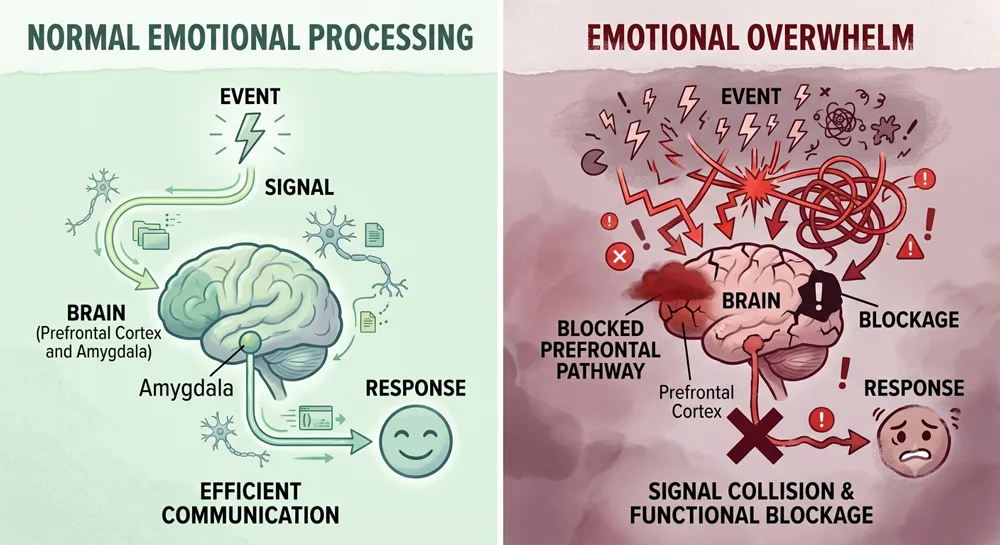
Emotional overwhelm happens when the volume and intensity of emotional input exceeds your current capacity to process it.
Think of your brain as a relay station. Under normal conditions, emotional signals travel from the limbic system, specifically the amygdala, toward the prefrontal cortex, where you make sense of them, weigh options, and choose responses. That relay works smoothly most of the time.
When input floods in too fast, or when the signal is already too intense, the amygdala essentially takes over. This is sometimes called “amygdala hijack,” a term popularized by psychologist Daniel Goleman. Your thinking brain goes offline, at least partially, and your body shifts into survival mode.
You don’t think your way out of that state. You feel it first, usually as a physical sensation.
This is why overwhelm so often arrives without a clear emotional label. You’re not neatly angry or cleanly sad. You’re overloaded. The feelings are all present at once, competing, and your brain cannot categorize them fast enough to give you useful information.
The Difference Between Strong Emotion and Overwhelm
Strong emotion is specific. Grief sits in the chest, pointed. Anger has an object. Even anxiety, diffuse as it is, usually has a focus.
Overwhelm is different. It blurs. Multiple emotional threads tangle at once, including present stress, old wounds, physical fatigue, and unexpressed feeling. The result is not one big feeling but a short-circuit: a sense that something is simply too much without a clear name for what that something is.
The Signs You’re Emotionally Overwhelmed
Recognizing emotional overwhelm before it peaks is genuinely useful. The window between “things are getting intense” and “I have completely lost the thread” is where your best interventions live.
Physical Signs
| Signal | What It Feels Like |
| Chest tightness or heaviness | Pressure without obvious physical cause |
| Shallow or held breath | You notice you’ve been barely breathing |
| Sudden fatigue | Energy drops sharply and unexpectedly |
| Headache or jaw tension | Muscles clench without conscious effort |
| Nausea or gut discomfort | Stomach reacts before your mind registers why |
Cognitive and Behavioral Signs
- Your thinking goes foggy or blank. Sentences stop mid-thought.
- Decision-making becomes impossible. Even small choices feel enormous.
- You withdraw from conversations or go very quiet suddenly.
- You feel the urge to escape: leave the room, cancel plans, go silent online.
- Crying arrives without a clear trigger, or you feel the pressure of tears you can’t actually release.
- Small irritations become disproportionately large. You snap, and then feel confused about your own reaction.
Emotional Signs
The feelings themselves often feel both too big and too vague at the same time. You might experience a crushing sense of being behind on everything. A nameless dread. The feeling that you are failing at something, though you can’t quite identify what. Emotional overwhelm signs frequently include shame about the overwhelm itself, which compounds the original experience.
Why Some People Overwhelm More Easily
This is one of the most important things to understand: emotional overwhelm is not distributed equally across people, and that’s not a reflection of strength.
Several factors genuinely increase vulnerability:
Nervous system sensitivity: Some people are born with a more reactive autonomic nervous system. Psychologist Elaine Aron’s research on Highly Sensitive People suggests roughly 15 to 20 percent of the population processes sensory and emotional information more deeply by default.
Cumulative stress load: A person managing chronic financial pressure, relationship difficulty, and poor sleep simultaneously has a much smaller emotional buffer than someone who is rested and resourced. Overwhelm thresholds are not fixed; they contract under sustained load.
Unprocessed emotional history: When earlier emotional experiences, particularly from childhood, never got fully processed, they stay in the system as unresolved charge. New situations that rhyme with old pain can trigger responses that seem out of proportion to the present moment.
Interoceptive awareness gaps: People who struggle to notice what’s happening in their bodies often miss the early signals of overwhelm and skip straight to the flooded state. They don’t realize how close to the edge they were until they’ve gone over it.
The Emotional Overwhelm Cycle
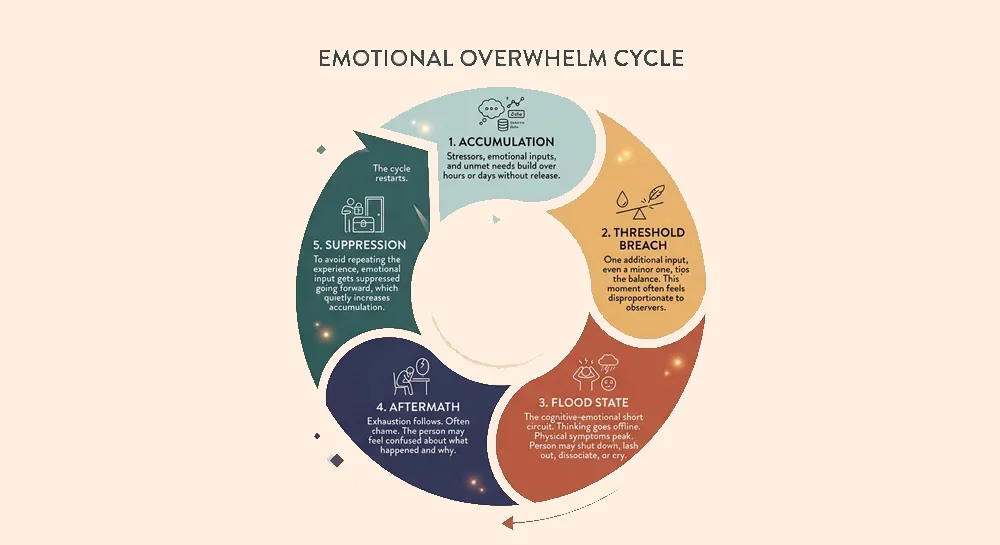
Overwhelm rarely arrives once and leaves cleanly. It tends to run in cycles, especially when unrecognized.
- Accumulation: Stressors, emotional inputs, and unmet needs build over hours or days without release.
- Threshold breach: One additional input, even a minor one, tips the balance. This moment often feels disproportionate to observers.
- Flood state: The cognitive-emotional short circuit. Thinking goes offline. Physical symptoms peak. The person may shut down, lash out, dissociate, or cry.
- Aftermath: Exhaustion follows. Often shame. The person may feel confused about what happened and why.
- Suppression: To avoid repeating the experience, emotional input gets suppressed going forward, which quietly increases accumulation. The cycle restarts.
Breaking the cycle requires interrupting it at the accumulation phase, before the threshold breaches. That’s where recognition becomes a practical tool, not just a concept.
What to Do When Emotions Feel Too Much
In the Moment: Interrupt the Flood State
Physiological sigh: Two short inhales through the nose followed by a long exhale through the mouth. Research from Stanford’s lab of Andrew Huberman shows this specific breath pattern deflates the alveoli in the lungs and rapidly downregulates the sympathetic nervous system. It works in under 60 seconds.
Sensory grounding: Name five things you can see, four you can touch, three you can hear. This is not magic; it’s a deliberate act of engaging the prefrontal cortex with concrete input, which competes with the amygdala’s flood signal.
Temperature: Cold water on the face or wrists activates the mammalian dive reflex and slows heart rate measurably. If you’re in an office bathroom, running cold water over your wrists for 30 seconds does something real.
Name what you can: Even partial labeling matters. Research by Matthew Lieberman at UCLA demonstrated that naming an emotion reduces amygdala activity. You don’t need a precise label. “This feels like too much at once” is enough to begin.
After the Flood: Rebuild Capacity
| Strategy | Why It Works |
| Journaling without a goal | Externalizes tangled feelings, reduces working memory load |
| Physical movement | Metabolizes stress hormones that build during overwhelm |
| Talking to a trusted person | Co-regulation; another nervous system helps settle yours |
| Sleep prioritization | The single most effective emotional buffer restoration tool |
| Reducing input temporarily | Screens, news, social demands all add to the load; a deliberate pause lowers baseline |
FAQs
What is emotional overwhelm exactly?
Emotional overwhelm is the state in which incoming emotional stimuli exceed your nervous system’s current capacity to process and regulate them. The result is a partial shutdown of rational thinking, combined with physical stress responses like tightness, fatigue, or blankness. It is not a personality flaw. It is a system under load responding predictably to being overloaded. With the right tools and enough self-awareness, it can be both recognized early and recovered from more quickly.
What are the most common signs of emotional overwhelm?
The most recognizable emotional overwhelm signs include chest tightness, sudden mental fog, disproportionate irritability, the urge to withdraw, and crying without a clear reason. Many people also experience a strong need to escape or isolate, an inability to make even small decisions, and physical symptoms like headaches or nausea. Because these signs are physical as well as emotional, they’re often mistaken for something else entirely.
Why do my emotions feel too much even during small things?
When emotions feel too much in response to small triggers, it usually means the accumulation phase was already well advanced before that trigger arrived. The small thing didn’t cause the overwhelm; it revealed how much was already built up underneath. Chronic fatigue, unresolved stress, sensitivity of the nervous system, and old emotional material that hasn’t been processed are all common contributors. The visible trigger is rarely the real source.
Is emotional overwhelm the same as a panic attack?
Emotional overwhelm and panic attacks share some physical symptoms, including breathlessness and chest pressure, but they are not the same. A panic attack is typically more acute, peaks faster, and often involves a strong fear of something catastrophic happening physically. Emotional overwhelm tends to build more gradually, presents more as shutdown or numbness than acute fear, and is more directly tied to emotional context. That said, unmanaged emotional overwhelm can sometimes escalate into panic. If panic attacks are recurring, speaking with a mental health professional is worth prioritizing.
Conclusion
Priya, sitting frozen at her desk, wasn’t broken. Her brain was doing exactly what brains do when too much arrives at once: it pulled the circuit breaker.
Understanding that is the first genuinely useful shift. Emotional overwhelm is not evidence of weakness. It is a signal: load exceeds current capacity. That’s solvable information.
The path forward involves two things working together. Short-term, you need tools that work in the moment, the breath, the cold water, the partial naming. Long-term, the work is about building emotional capacity: processing what accumulates, resting the system, and learning to catch the early signs before the threshold breaks.
You don’t need to eliminate strong emotions to live well. You need to build a relationship with them that keeps you in the conversation, rather than being silenced by the noise.
Start with the next breath. Literally.
References
- Princeton University Press — The Neuroscience of Emotion (Feldman Barrett & Russell)
- Aron, E.N. — The Highly Sensitive Person (1996); hsperson.com
- Huberman Lab, Stanford University — Research on physiological sigh and stress regulation; hubermanlab.com
- Lieberman, M.D. et al. — “Putting Feelings into Words: Affect Labeling Disrupts Amygdala Activity in Response to Affective Stimuli” — Psychological Science, 2007