
Key Takeaways
- Self-compassion is not self-pity or weakness. It is an active, evidence-backed practice of responding to your own suffering with the same warmth you would offer a close friend.
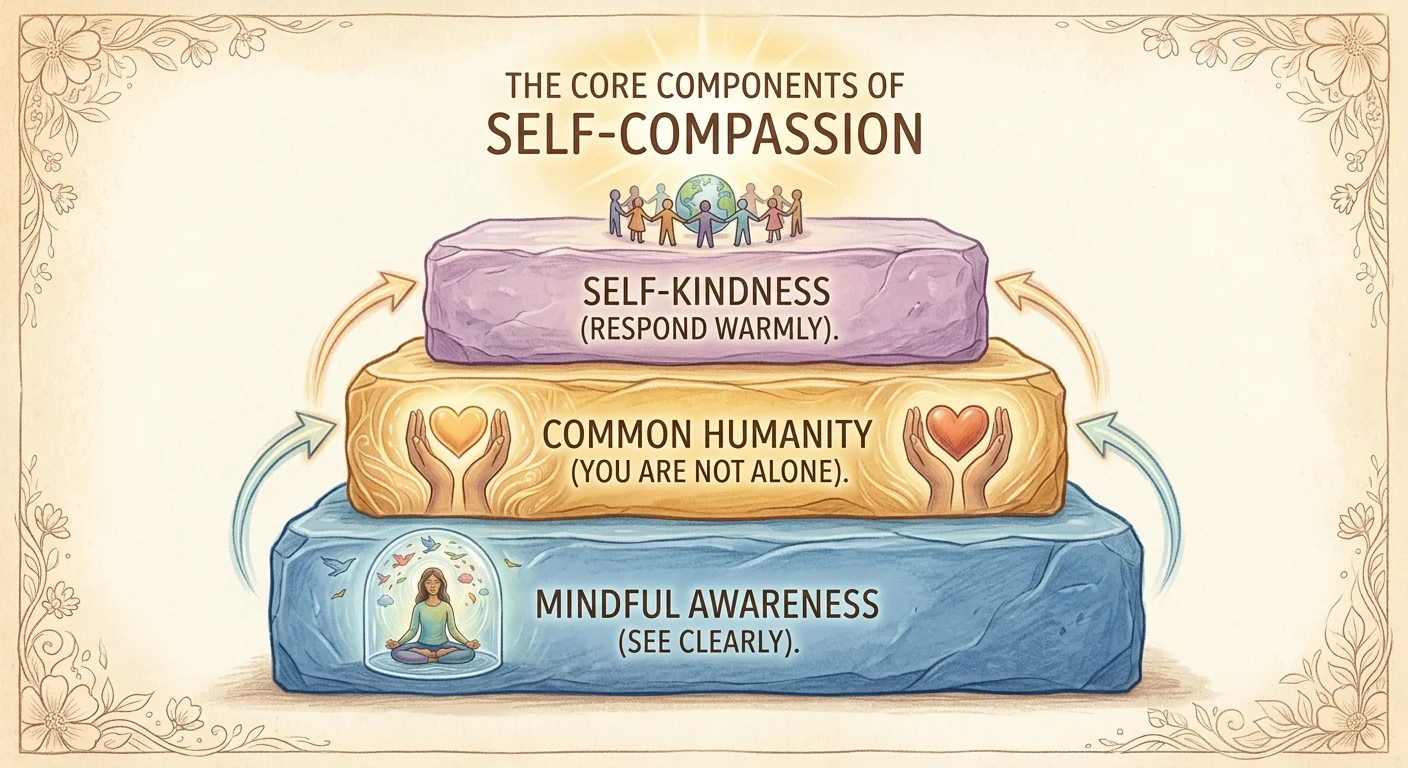
- Dr. Kristin Neff’s research identifies three core components: self-kindness, common humanity, and mindful awareness of pain.
- People who practise self-compassion consistently show lower anxiety, less depression, and greater emotional resilience, not by avoiding difficulty, but by moving through it more wisely.
- Practical exercises like the Self-Compassion Break and compassionate letter-writing can shift your inner dialogue within weeks.
Introduction
Picture a colleague telling you they failed a big presentation. They are visibly crushed. Most of us know exactly what to do: we lean in, we say something kind, maybe we remind them of the ten presentations they nailed before this one. We do it instinctively.
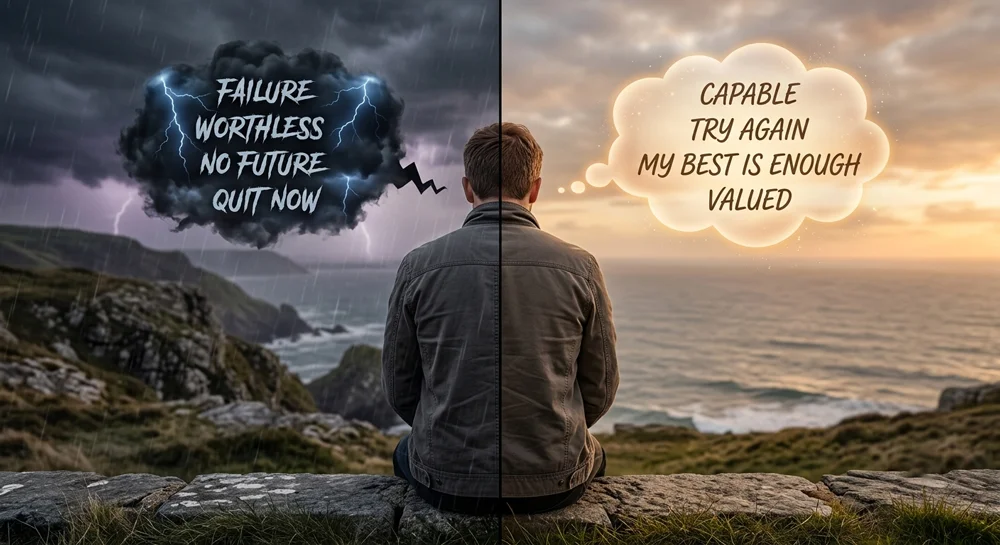
Now picture the same scene, except you are the one who failed. What does your inner voice say?
For most people, it turns harsh. Suddenly the tone shifts from warmth to criticism, from perspective to catastrophe. You would never speak to a friend the way you speak to yourself after a setback. That gap, between how we treat others and how we treat ourselves, is precisely where self-compassion lives.
Self-compassion is not a personality trait you either have or lack. It is a learnable skill, one backed by over two decades of psychological research and measurable in brain scans, stress hormones, and wellbeing surveys. This guide walks you through what it genuinely means, why most of us resist it, and exactly how to begin practising it in everyday life.
“If you had a friend who spoke to you in the same way that you sometimes speak to yourself, how long would you allow that person to be your friend?” — Dr. Kristin Neff, Self-Compassion researcher, University of Texas at Austin
What Self-Compassion Actually Means
Self-compassion is the practice of turning the same care, patience, and understanding toward yourself that you would naturally direct at someone you love when they are struggling.
That definition sounds simple. The lived experience of it is not.
We carry a cultural narrative that equates self-criticism with ambition and self-kindness with complacency. If you go easy on yourself, so the story goes, you will stop trying hard. Self-compassion directly challenges that story, with evidence.
Psychologist Dr. Kristin Neff, who pioneered the formal study of self-compassion in the early 2000s, defines it as a distinct psychological construct separate from self-esteem, self-pity, or narcissism [Source: self-compassion.org / Neff, K.D., 2003]. Her model gives us three concrete, workable components rather than a vague instruction to “be nicer to yourself.”
The Three Pillars
Self-Kindness
Self-kindness means actively soothing yourself during pain rather than judging yourself for feeling it. It is not passive. It requires noticing that you are hurting and consciously choosing a warm response instead of a cold one.
Think of Arjun, a software engineer who shipped a bug that took down a production service for two hours. His immediate reaction was a spiral of “I am terrible at this job, how did I miss that, everyone thinks I’m incompetent.” A self-kind response does not deny the mistake. It says: “That was a tough situation. Mistakes happen, especially under pressure. What can I learn here?”
The outcome is different. Arjun in the first scenario is so caught in shame he can barely think straight. Arjun in the second scenario can actually review the bug and fix the process.
Common Humanity
Suffering is not a personal flaw. It is the most universal human experience there is.
Common humanity is the recognition that struggle, failure, and imperfection are not evidence that something is uniquely wrong with you. They are simply part of what it means to be alive and to try things. When you feel isolated by your pain (“no one else messes up like I do”), you amplify it. When you remember that everyone around you carries their own version of this exact weight, the pain softens.
This is not toxic positivity. It is accurate perspective.
Mindful Awareness
You cannot respond compassionately to suffering you refuse to acknowledge. Mindful awareness means seeing your pain clearly, without exaggerating it into catastrophe and without pushing it away with “I shouldn’t feel this way.”
It is the difference between “I am a failure” (over-identification, catastrophe) and “I notice I’m feeling disappointed and embarrassed right now” (clear, grounded observation). The second framing creates space. Space is where self-compassion can actually operate.
Pillar | What it replaces | The shift it creates |
Self-Kindness | Self-criticism and harsh judgment | Emotional safety and motivation |
Common Humanity | Isolation and shame | Perspective and connection |
Mindful Awareness | Suppression or over-identification | Clarity and response-ability |
Self-Compassion vs. Self-Esteem
Many people conflate self-compassion with self-esteem. They are related but fundamentally different, and that difference matters enormously for your wellbeing.
Self-esteem is contingent. It rises when you succeed and falls when you fail. It often requires you to compare yourself favourably to others to feel good. That is an unstable foundation. When the promotion goes to someone else, or the project collapses, self-esteem can evaporate overnight.
Self-compassion is unconditional. It does not require you to perform well or rank above others. It simply responds to the fact that you are a human being capable of suffering, and that this alone warrants kindness.
Research from Dr. Neff and colleagues found that self-compassion predicts emotional resilience, life satisfaction, and lower anxiety and depression more reliably than self-esteem, without the social comparison trap [Source: Neff, K.D. & Vonk, R., 2009, Self-Compassion Versus Global Self-Esteem].
| Self-Esteem | Self-Compassion |
Based on | Performance and comparison | Common humanity and presence |
Stable when | Things go well | Things go well or badly |
Reaction to failure | Crashes, defends, or blames | Acknowledges, learns, recovers |
Requires others to | Lose or be “less” | Simply exist as equals |
Why We Resist Being Kind to Ourselves
Here is the uncomfortable truth: most people find self-compassion harder than self-criticism. And there are real psychological reasons for that.
Fear of complacency: The most common objection is “if I stop being hard on myself, I’ll lose my drive.” Decades of research say the opposite. Self-criticism activates the body’s threat system. Your nervous system treats inner attacks the same way it treats external danger: by narrowing thinking, increasing cortisol, and reducing the capacity for creative problem-solving. Self-compassion, by contrast, activates the care system, the same neurological circuitry that helps mammals care for their young. That system is built for learning, growth, and persistence after setbacks [Source: Gilbert, P., The Compassionate Mind, 2009].
Feeling undeserved: Many of us were implicitly taught that kindness must be earned. Receiving it without earning it feels wrong, even from ourselves. This is particularly common among people raised in environments where conditional love or high criticism were the norm.
Mistaking it for weakness: There is a cultural script, especially in professional environments, that equates toughness with self-criticism and kindness with softness. This script is simply wrong, and the data backs that up. Soldiers, athletes, and surgeons who practise self-compassion show greater grit, not less [Source: Hiraoka, R. et al., 2015, Self-Compassion as a Prospective Predictor of PTSD Symptom Severity].
A Practical Framework: From Harsh Judge to Fair Witness
Self-Compassion Exercises You Can Try Today
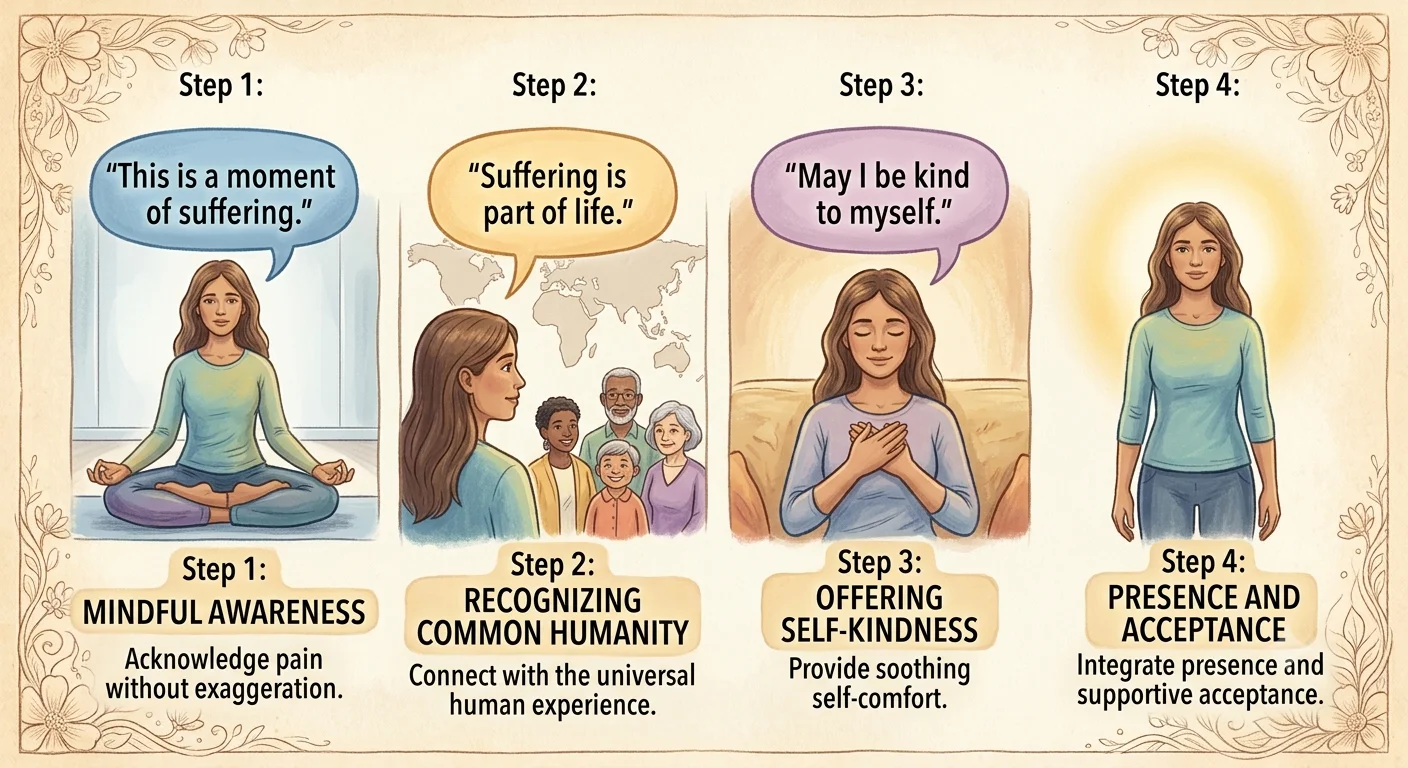
The Self-Compassion Break (3 Minutes)
This is Dr. Neff’s signature foundational practice. Use it any time you notice you are suffering, stressed, or being hard on yourself.
- Place one hand on your heart or your cheek. Feel the warmth and gentle pressure.
- Say to yourself (silently or aloud): “This is a moment of suffering.” (Mindful awareness.)
- Then: “Suffering is a part of life. I am not alone in this.” (Common humanity.)
- Then: “May I be kind to myself right now.” (Self-kindness.)
That is it. Three sentences. Two minutes. The physical touch is not symbolic, it triggers oxytocin release and physiologically shifts your nervous system toward calm [Source: Porges, S., The Polyvagal Theory, 2011].
The Compassionate Letter
Think of a situation where you feel shame, inadequacy, or pain. Now write a letter to yourself about it, but write it from the perspective of a deeply kind, wise friend who sees your full humanity and still cares about you.
Do not write what you think you should say. Write what a genuinely loving, clear-eyed friend actually would say.
Read it back. Notice the shift.
This exercise is used in clinical settings for everything from trauma recovery to performance anxiety, and controlled trials show measurable reductions in self-criticism after just a few sessions [Source: Leary, M.R. et al., 2007, Self-Compassion and Reactions to Unpleasant Self-Relevant Events].
Reframing the Inner Critic
When your inner voice is harsh, try this: notice the specific words it uses. Then ask yourself, “Would I say this, in this tone, to someone I love who is going through the same thing?”
Almost always, the answer is no.
The next step is not silencing the critic. It is translating it. “You always mess this up” becomes “You made a mistake. What would help you do better next time?” Same concern, completely different register. Over time, this rewires the default.
Mindful Self-Compassion Journaling
End three days a week with two questions in a notebook:
- What did I find difficult today, and how did I speak to myself about it?
- What would I have said to a good friend in the exact same situation?
The gap between your two answers is where your practice lives.
What the Research Says
Self-compassion is not a wellness trend. It has been studied rigorously across clinical, educational, military, and athletic populations.
Key findings from peer-reviewed research include:
- People higher in self-compassion show significantly lower rates of anxiety and depression [Source: MacBeth, A. & Gumley, A., 2012, meta-analysis of 18 studies]
- Self-compassionate students respond to academic failure by studying harder, not less, compared to high self-esteem peers
- In veterans with PTSD, self-compassion predicted lower symptom severity prospectively, meaning it protected against worsening over time [Source: Hiraoka et al., 2015]
- Eight-week Mindful Self-Compassion (MSC) programs consistently show improvements in wellbeing, compassion for others, and life satisfaction, with gains maintained at follow-up [Source: Neff, K.D. & Germer, C.K., 2013]
This is not feel-good advice. It is one of the better-evidenced psychological tools we have for sustainable wellbeing.
FAQs
What is self-compassion and how is it different from self-pity?
Self-compassion is the practice of responding to your own pain, failure, or inadequacy with kindness, perspective, and clear awareness rather than harsh judgment. Self-pity, by contrast, magnifies suffering and reinforces a sense of isolation. Self-compassion connects your experience to shared human vulnerability, which actually reduces the intensity of pain rather than dwelling in it.
How do I start practising self-compassion as a beginner?
The simplest starting point is the Self-Compassion Break: pause when you notice suffering, place a hand on your heart, and silently say three phrases covering mindful awareness, common humanity, and self-kindness. This takes under three minutes and can be done anywhere. Daily journaling that contrasts your inner critic’s tone with what you would say to a friend is equally powerful for beginners.
Does self-compassion make you less motivated or ambitious?
No. Research consistently shows that self-compassion improves motivation after failure, not reduces it. Self-criticism triggers the threat system, narrowing your thinking and increasing avoidance. Self-compassion activates the care and growth system, which supports learning, persistence, and trying again. Athletes and high performers who practise it tend to recover from setbacks faster and perform more consistently.
Can self-compassion help with anxiety and depression?
Yes, and the evidence is robust. A 2012 meta-analysis of 18 studies found that higher self-compassion consistently correlates with lower anxiety and depression across diverse populations. Structured programmes like Mindful Self-Compassion (MSC) have shown clinical-grade improvements in both conditions in randomised controlled trials.
The Practice Begins with One Moment
Self-compassion does not ask you to suddenly love yourself or erase your inner critic overnight. It asks something much smaller and more achievable: that the next time you are suffering, you pause for two minutes and treat yourself the way you would treat someone you genuinely care about.
That is the whole practice, repeated over time.
The research is clear. The techniques are accessible. The only real barrier is the deeply ingrained belief that you do not deserve the same kindness you freely give to others. That belief is worth examining, because it has no basis in evidence and a measurable cost to your health, your relationships, and your ability to grow.
Start with the Self-Compassion Break today. Write the letter this week. Notice, over the next month, whether your inner voice begins to shift from prosecutor to trusted advisor. Most people who try this are surprised, not by how soft it feels, but by how much clearer and steadier they become.
References
- Neff, K.D. (2003). Self-Compassion: An Alternative Conceptualization of a Healthy Attitude Toward Oneself. Self and Identity. — self-compassion.org
- Neff, K.D. & Vonk, R. (2009). Self-Compassion Versus Global Self-Esteem: Two Different Ways of Relating to Oneself. Journal of Personality.
- MacBeth, A. & Gumley, A. (2012). Exploring Compassion: A Meta-Analysis of the Association between Self-Compassion and Psychopathology. Clinical Psychology Review.
- Gilbert, P. (2009). The Compassionate Mind. Constable & Robinson.
- Neff, K.D. & Germer, C.K. (2013). A Pilot Study and Randomized Controlled Trial of the Mindful Self-Compassion Program. Journal of Clinical Psychology.