
Key Takeaways
- Catastrophic thinking is a cognitive distortion rooted in evolutionary threat-detection, not personal weakness or pessimism.
- The brain’s negativity bias makes bad outcomes feel more probable and more vivid than neutral or positive ones by design.
- Catastrophizing follows a predictable three-stage escalation pattern that can be identified and interrupted at each stage.
- Evidence-based techniques from CBT and ACT, including probability testing, decatastrophizing, and compassionate self-inquiry, measurably reduce worst-case thinking over time.
Introduction
You get a message from your manager: “Can we talk later?” Your stomach drops. By the time the meeting arrives, you have already mentally rehearsed being fired, losing your apartment, and explaining the gap on your CV two years from now.
The meeting turns out to be about shifting your project deadline.
Sound familiar? That rapid, unstoppable slide from a neutral event to a fully realized catastrophe is not dramatic overreaction. It is a specific cognitive pattern called catastrophic thinking, and it is far more common, and far more understandable, than most people realize.
The question worth asking is not “why am I like this?” as though something is fundamentally wrong with you. The real question is: what is this pattern trying to do, where did it come from, and why does it keep running even when there is no actual fire?
Catastrophizing sits at the intersection of biology, learned behavior, and unprocessed experience. It is one of the most well-documented cognitive distortions in clinical psychology, appearing consistently in anxiety disorders, depression, chronic pain conditions, and post-traumatic stress.
Understanding the mechanics behind worst-case thinking is the first step toward loosening its grip. Not eliminating it entirely, your brain will always run threat simulations, but reducing how far the spiral goes before you can catch it.
“The mind is its own place, and in itself can make a heaven of hell, a hell of heaven. The problem is that for anxious minds, the default setting leans heavily toward one of those directions.” — Adapted from cognitive behavioral psychology principles
What Catastrophic Thinking Actually Is
The Clinical Definition
Catastrophizing is a cognitive distortion in which a person assumes the worst possible outcome is not only possible but probable, and that if it occurs, it will be entirely unbearable. Psychologists identify two overlapping processes within it:
Magnification: Exaggerating the significance or likelihood of a negative event. Minimization: Simultaneously shrinking your perceived ability to cope with that event.
Together, they create a double bind. The threat feels enormous. You feel small. The spiral becomes almost inevitable.
What It Looks and Sounds Like
Catastrophic thinking rarely announces itself plainly. It tends to arrive disguised as reasonable concern or careful planning. These are some of its most common forms:
Pattern | Example Thought |
Chain catastrophizing | “If I make a mistake at work, I’ll get fired, then I can’t pay rent, then I’ll lose everything.” |
Health anxiety spiral | “That headache could be something serious. What if it’s a tumor?” |
Social catastrophizing | “I said something awkward. Everyone noticed. They think I’m an idiot.” |
Future foreclosure | “This relationship problem won’t get better. It never does. I’ll end up alone.” |
Retrospective catastrophizing | “I handled that badly. I always do. I’m fundamentally incapable.” |
The common thread is the leap. Something small, uncertain, or mildly negative becomes the opening scene of an irreversible disaster, with very little logical scaffolding connecting the two.
Why Your Brain Defaults to Worst-Case Scenarios
The Negativity Bias: Built In, Not Chosen
Your brain processes negative information more thoroughly, remembers it more vividly, and weighs it more heavily than equivalent positive information. This is called the negativity bias, and it is not a flaw in your personality. It is a feature of human neural architecture.
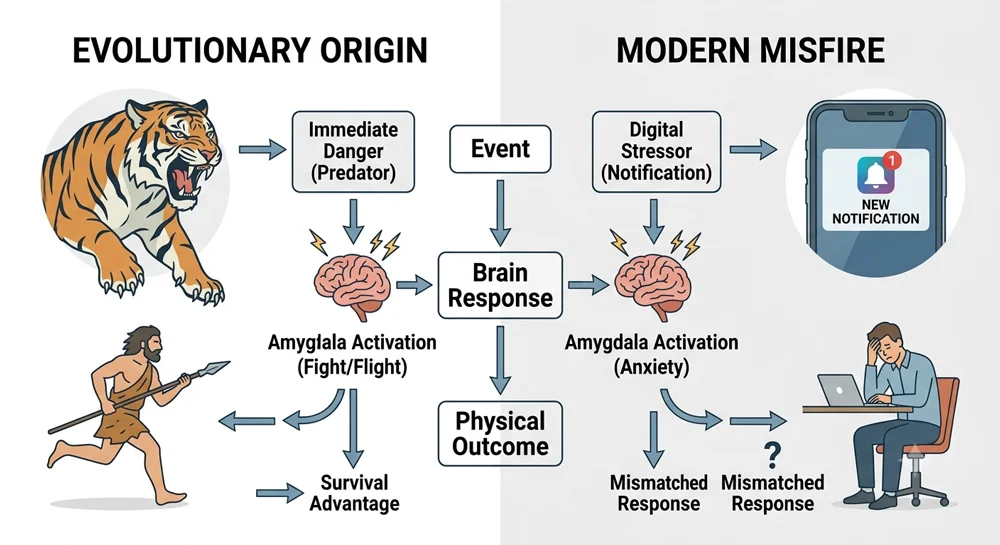
Neuroscientist Rick Hanson describes the brain as having “Velcro for bad experiences and Teflon for good ones.” From an evolutionary standpoint, this makes complete sense. Missing a positive opportunity, a ripe berry patch, costs you a meal. Missing a negative threat, a predator, costs you your life. Brains that over-weighted negative signals survived. Brains that didn’t, didn’t.
The result is a nervous system primed to detect, amplify, and dwell on potential danger, even when the danger is a mildly ambiguous text message.
The Role of Uncertainty
Catastrophic thinking almost always activates in the presence of uncertainty, not confirmed bad news, but possible bad news. Research by neuroscientist Archy de Berker and colleagues found that uncertain threats are actually more stressful to the brain than certain ones.
When outcomes are unknown, the threat-simulation system stays running. Your brain keeps generating scenarios, each slightly worse than the last, because it cannot find a definitive signal to stop. Catastrophizing is, in part, your brain’s attempt to prepare for every possibility by imagining them all.
Learned Threat Templates
Biology is not the whole story. Many people develop catastrophic thinking patterns through experience, particularly early experiences in environments where bad things happened without warning, where caregivers were unpredictable, or where expressing vulnerability was unsafe.
When a child grows up in an environment where bad outcomes were frequent and unpredictable, their nervous system learns a very specific lesson: assume the worst early, so you’re never caught off guard. What once served as genuine protection becomes, in adulthood, an automatic cognitive habit running long past its usefulness.
The Anatomy of a Catastrophic Thought
Most catastrophic spirals follow a recognizable three-stage escalation. Learning to identify which stage you’re in gives you an interruption point at each one.
Stage One: The Trigger
A neutral or mildly negative event occurs. A delayed text reply. A strange sensation in your body. A slightly flat tone in someone’s voice. Critically, the event itself does not cause the catastrophizing. Your brain’s interpretation of the event does.
At this stage, the thought is still relatively containable: “That’s unusual.”
Stage Two: The Leap
This is where catastrophizing proper begins. The brain, running its threat-simulation process, jumps from the present ambiguity to a future worst case. The leap is rarely logical, but it moves with tremendous speed and emotional force.
“That’s unusual” becomes “something is wrong” becomes “this is very bad” becomes “this could ruin everything.”
The emotional experience at this stage, the tightening chest, the shallow breathing, the dread, feels like evidence that the worst-case scenario is real. This is a critical confusion. Feeling afraid does not mean the thing you fear is likely.
Stage Three: The Helplessness Amplifier
The final stage adds a second layer: not only will the worst happen, but you will be unable to cope with it. This is where catastrophizing crosses from anxious thinking into genuine despair.
Interrupting at Stage One is easiest. Stage Two is harder but very possible with practice. Stage Three requires a specific kind of challenge, not to the likelihood of the bad outcome, but to your assumed inability to survive it.
How Catastrophizing Affects Your Body and Life
The Physical Cost
Because your brain cannot fully distinguish between imagined threat and real threat, catastrophic thinking triggers a genuine physiological stress response. Cortisol rises. Heart rate increases. Muscles tense. The body is preparing for a disaster that exists only in the mind.
People who catastrophize chronically carry measurably higher baseline cortisol levels and report significantly higher rates of sleep disruption, chronic muscle tension, headaches, and fatigue. The imagination is not harmless. It has a biological price.
The Behavioral Narrowing
Over time, catastrophic thinking quietly shrinks your life. You avoid the job application because you’ve already imagined the rejection. You don’t go to the social event because you’ve pre-lived the awkwardness. You delay the medical appointment because you’ve already diagnosed yourself with something serious.
Each avoidance provides short-term relief and long-term confirmation: the world is dangerous, and you are not equipped to handle it.
The Relationship Toll
Catastrophizing in relationships is particularly corrosive. A partner who is quiet becomes a partner who is resentful becomes a relationship that is ending. That story, told internally with complete conviction, changes how you behave. You become withdrawn, or accusatory, or desperate for reassurance, all in response to a narrative you generated entirely alone.
This is not a criticism of people who do this. It is a description of how powerfully the mind shapes behavior even when operating on fiction.
Seven Practical Ways to Interrupt the Pattern
Name It to Tame It
The moment you recognize a catastrophic spiral beginning, say it plainly: “I’m catastrophizing right now.” Not as self-criticism, as observation.
Neuroscience research by Matthew Lieberman at UCLA found that labeling an emotional state with words reduces amygdala activation and increases prefrontal cortex engagement. You are literally shifting processing from the threat-detection center to the reasoning center by naming what’s happening.
Run the Probability Check
Ask yourself: “If I had to assign a percentage likelihood to this worst-case outcome actually happening, what would it be?”
Most catastrophic outcomes, when examined honestly, carry probabilities in the single digits. The exercise is not to dismiss your concern but to restore proportion. Your emotional system is reporting near-certainty. Your rational assessment, with a little distance, tells a different story.
Decatastrophize with “And Then What?”
This technique, used within CBT frameworks, follows the spiral all the way to its end rather than stopping it. Take the worst case: it happens. And then what? You lose the job. And then what? You look for another one. And then what? It takes time, it’s hard, but you find one. And then what?
Chasing the catastrophe to its conclusion almost always reveals something the spiral never shows you: you survive. You cope. Life continues. The technique works because it dismantles the assumption in Stage Three that the outcome would be unbearable.
The Best Case / Most Likely Case Exercise
Catastrophizing defaults to worst-case as though it were the only scenario worth considering. A simple rebalancing exercise forces the brain to generate alternatives.
Take any situation you’re catastrophizing about and write three columns:
Worst Case | Best Case | Most Likely Case |
Write the catastrophe | Write the ideal outcome | Write the realistic, boring, probable outcome |
Almost universally, the most likely case is somewhere in the middle, mundane, manageable, and entirely survivable. The exercise is not toxic positivity. It is restoring statistical reality to a brain that has been running on worst-case modeling.
Separate the Story from the Sensation
Much of what powers catastrophic thinking is the body’s stress response. The tight chest, the racing heart, the pit in the stomach all feel like confirmation that something terrible is happening or about to happen.
Practicing the skill of noticing physical sensations without automatically interpreting them as evidence of danger is core to both mindfulness-based stress reduction (MBSR) and ACT. “I notice tightness in my chest” is fundamentally different from “something is wrong.” One is observation. The other is interpretation.
The Compassionate Observer Question
When caught in a spiral, try asking: “What would I say to a close friend who came to me with this exact thought?”
Almost always, we offer others a perspective we deny ourselves. You would not tell your friend, “You’re right, you’re probably going to lose everything.” You would offer proportion, context, and faith in their ability to cope. That voice is available to you too. It simply requires a deliberate change of perspective to access it.
Limit Reassurance-Seeking and Checking
As with worry, the temporary relief from reassurance-seeking, checking symptoms online, replaying conversations, asking others repeatedly if everything is okay, trains the brain that catastrophic uncertainty is intolerable and must be resolved immediately.
Each check reinforces the belief that the threat was real enough to investigate. Over time, your threat threshold drops and the spirals begin more easily. Sitting with uncertainty, building it as a practiced skill, is uncomfortable and genuinely effective.
When Worst-Case Thinking Signals Something Deeper
Catastrophic thinking is a feature of many clinical conditions, not just a quirky cognitive habit. It is a central mechanism in:
- Generalized Anxiety Disorder (GAD): Pervasive, uncontrollable worst-case thinking across multiple life domains
- Health Anxiety (Illness Anxiety Disorder): Catastrophizing centered specifically on physical symptoms and medical outcomes
- PTSD: Worst-case thinking as a hypervigilance response to past trauma
- Depression: Catastrophizing about the past and future simultaneously, often combined with hopelessness
- Chronic Pain: Research consistently links pain catastrophizing to increased pain intensity and poorer outcomes
If catastrophic thinking is present most days, significantly disrupts your functioning, has been happening for six months or more, or is accompanied by physical symptoms, avoidance behaviors, or persistent low mood, speaking with a psychologist or therapist is not an overreaction. Cognitive Behavioral Therapy has an exceptionally strong evidence base specifically for catastrophizing, and many people see meaningful improvement within 8 to 16 sessions.
FAQs
What is catastrophic thinking?
Catastrophic thinking is a cognitive distortion in which a person automatically assumes the worst possible outcome to a situation is likely, and that they will be unable to cope if it occurs. It involves two simultaneous errors: overestimating the probability of a negative event and underestimating one’s capacity to handle it. Catastrophizing appears across anxiety disorders, depression, and chronic pain conditions and is one of the most commonly identified thinking patterns in cognitive behavioral therapy.
Why do I always think of the worst-case scenario?
Your brain is wired to prioritize threats over neutral or positive information through a mechanism called the negativity bias. This is an evolved survival feature, not a personal failing. Worst-case thinking intensifies when you are under chronic stress, have a history of unpredictable or threatening environments, or have developed the cognitive habit of treating uncertainty as danger. The good news is that cognitive habits, unlike genetic traits, can be identified, practiced against, and changed.
Is catastrophizing a form of anxiety?
Catastrophizing is not a standalone diagnosis but it is a core cognitive mechanism in anxiety disorders, particularly Generalized Anxiety Disorder, Health Anxiety, and Panic Disorder. It also plays a significant role in depression and PTSD. Many people catastrophize without meeting the criteria for any clinical diagnosis, existing instead on a spectrum of anxious thinking that causes real distress without crossing into disorder territory. Where the pattern causes meaningful suffering or behavioral restriction, it is worth addressing regardless of clinical labels.
How do I stop catastrophic thinking in the moment?
The fastest in-the-moment interventions are naming the pattern (“I’m catastrophizing”), running a quick probability check on the actual likelihood of the worst-case outcome, and doing a brief physiological reset through extended-exhale breathing to reduce amygdala activation. For longer-term change, techniques like decatastrophizing, the best/most likely case exercise, and cognitive defusion practiced consistently over weeks reshape the automatic responses. No single technique works instantly every time; building a small toolkit and applying it repeatedly is what creates lasting change.
Conclusion
Your brain imagines the worst because it was built by millions of years of survival pressure to do exactly that. Every ancestor who assumed the rustle in the grass was a predator lived long enough to pass on that gene. The ones who assumed it was just the wind sometimes didn’t.
You are carrying that inheritance.
The problem is not that you have a threat-detection system. The problem is that the system was calibrated for a world of physical dangers and is now running on ambiguous emails, quiet partners, and strange bodily sensations. It needs recalibration, not removal.
The techniques in this article, from probability checking and decatastrophizing to compassionate self-inquiry and uncertainty training, are not about forcing positivity or silencing your instincts. They are about restoring proportion. About teaching your nervous system, slowly and through repeated experience, that uncertainty is not the same as catastrophe, and that you are more capable of handling difficulty than your worst moments make you feel.
Start with one technique. Apply it consistently. And when the spiral starts again, because it will, meet it with curiosity instead of shame. It is just your brain doing its oldest job. You are simply learning to give it better information.
If catastrophic thinking is significantly affecting your daily life, please reach out to a licensed mental health professional. Effective, evidence-based support is available, and you do not have to navigate this alone.