

Key Takeaways
- Chronic worry is not a personality flaw. It is a misfiring threat-detection system that learned to stay on.
- The harder you try to suppress an anxious thought, the stronger it returns. This is called the rebound effect.
- Worry has two distinct types: productive (solvable) and unproductive (hypothetical). Each requires a different response.
- Evidence-based techniques like scheduled worry time, cognitive defusion, and stimulus control can measurably reduce chronic mental loops.
Introduction
It’s 2 a.m. You’re not in danger. Nothing is on fire. Yet your mind is running a highlight reel of everything that could go wrong, replaying a conversation from three days ago, and quietly catastrophizing about something that may never happen.
You tell yourself to stop. The thought comes back louder.
If this sounds familiar, you are not alone and you are not fragile. Roughly 6.8 million adults in the US alone are estimated to meet criteria for Generalized Anxiety Disorder, a condition defined primarily by chronic, uncontrollable worry. Many more sit just below that threshold, worrying in ways that quietly drain their energy, disrupt their sleep, and narrow their lives without ever receiving a formal diagnosis.
The reason worry feels impossible to stop is not a lack of willpower. It is biology. Your brain has a mechanism specifically designed to keep you thinking about unresolved threats, and under certain conditions, it gets stuck in that mode. Understanding that mechanism, why it fires, why it loops, and what actually interrupts it, is the foundation of everything that helps.
This article walks through the science of anxious thoughts, why common advice like “just relax” fails so completely, and what the research actually shows about breaking the worry cycle for good.
“Worry is a thin stream of fear trickling through the mind. If encouraged, it cuts a channel into which all other thoughts are drained.” — Arthur Somers Roche
What Worry Actually Is (And Isn’t)
Worry Is a Cognitive Activity, Not an Emotion
This distinction matters more than it sounds. Anxiety is the feeling. Worry is what your mind does in response to that feeling: it generates verbal, language-based thoughts about potential future threats.
Research by psychologist Thomas Borkovec, one of the leading researchers on chronic worry, found that worry is predominantly a verbal-linguistic process. It lives in words and sentences in your head, not in images or physical sensations. This is why worrying can feel so circular. You keep narrating the problem without ever fully feeling and releasing it.
What Worry Was Designed to Do
At its origin, worry is a planning tool. When your ancestors faced a real problem, like a dwindling food supply or a hostile neighboring group, running through future scenarios and potential solutions was genuinely useful. That mental rehearsal helped them survive.
The issue is that this mechanism was never built with an off switch tied to whether the threat is real, solvable, or imminent. It activates for a job interview the same way it activates for a famine.
What Worry Is Not
Common Belief | Reality |
“Worrying means I care” | Caring and worrying are separate. You can plan and act without chronic mental loops. |
“Worrying keeps me prepared” | Chronic worry impairs decision-making and problem-solving. |
“If I stop worrying, things will go wrong” | This is magical thinking. Outcomes are not controlled by your anxiety levels. |
“Worrying is just who I am” | Worry patterns are learned and reinforced. They can also be unlearned. |
The Neuroscience Behind the Loop
The Default Mode Network and the Wandering Mind
When your brain is not focused on an external task, it activates a network of regions called the Default Mode Network (DMN). This network is responsible for self-referential thinking, planning, and mental simulation of future events.
In people with high trait anxiety, the DMN stays hyperactive even when they are trying to rest or focus on something else. The brain keeps pulling attention back inward, back to the unresolved, the uncertain, the what-ifs.
The Amygdala’s Role in Keeping Worry Alive
Your amygdala, the brain’s threat-detection hub, does not evaluate probability. It responds to possibility. A 0.1% chance of something catastrophic happening triggers almost the same response as a near-certainty, because from an evolutionary standpoint, missing a real threat was always more costly than a false alarm.
This is why rational arguments rarely dissolve worry. The amygdala is not persuaded by logic. It is persuaded by felt safety: physical signals, behavioral patterns, and environmental cues that tell it the threat has passed.
Why the Loop Repeats
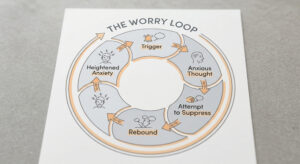
Worry loops because the brain treats an unresolved mental concern the same way it treats an open task. This is related to what psychologists call the Zeigarnik Effect: our minds hold on to incomplete things more tenaciously than completed ones.
If the worry never reaches a resolution, a decision, an action, or a genuine acceptance of uncertainty, it stays flagged as “open.” The brain keeps pinging it.
Why Telling Yourself to Stop Doesn’t Work
The White Bear Problem
In 1987, Harvard psychologist Daniel Wegner ran a now-famous experiment. He told participants: do not think about a white bear. Within seconds, nearly all of them thought about a white bear, and continued to do so far more frequently than a control group who were simply allowed to think freely.
This is thought suppression, and it reliably backfires.
When you instruct your brain to avoid a specific thought, the monitoring process that checks whether you’re succeeding keeps activating the very thought you’re trying to avoid. The harder you push, the more present the thought becomes.
What “Just Relax” Gets Wrong
Telling an anxious person to relax is a bit like telling someone with a broken leg to walk it off. The instruction is not wrong in principle, relaxation does help, but it misidentifies where the problem lives.
Relaxation techniques work not because they overpower the worry, but because they shift the body’s physiological state, which then changes the brain’s threat assessment. The sequence matters. Body first, mind second.
The Reassurance Trap
Seeking reassurance, asking someone repeatedly if things will be okay, Googling symptoms obsessively, checking and rechecking, feels like it reduces worry. And it does, briefly. But each reassurance-seeking behavior trains the brain that uncertainty is intolerable and must be resolved immediately.
Over time, your threshold for tolerating uncertainty drops. You need more reassurance more often. The worry grows.
The Worry Types: Productive vs. Unproductive
This single distinction, separating worries you can actually act on from ones you cannot, is one of the most practically useful tools in managing chronic anxious thoughts.
How to Tell Them Apart
Ask yourself one direct question: “Is there a concrete action I can take about this in the next 24-48 hours?”
Worry Type | Characteristics | Right Response |
Productive worry | Based on a real, current situation. Has a possible action step. | Problem-solve. Make a plan, schedule it, act on it. |
Unproductive worry | Hypothetical, future-focused, often begins with “What if…” | Acknowledge it, don’t engage with the content. Use defusion techniques. |
The majority of chronic worry falls into the unproductive category. Studies suggest that roughly 85% of things people worry about never happen, and of the 15% that do, most people cope significantly better than they predicted they would.
The goal with unproductive worry is not to solve it. There is nothing to solve. The goal is to stop treating it like an open problem that requires your continued attention.
Six Evidence-Based Ways to Stop the Loop
Scheduled Worry Time
This technique, developed within Cognitive Behavioral Therapy (CBT) frameworks, sounds counterintuitive but has consistent research support.
Choose a 20-30 minute window each day as your designated worry time. A specific chair, a specific time, not near bedtime. When a worry surfaces outside that window, you don’t fight it. You note it and postpone it: “I’ll think about that at 5 p.m.”
What this does is remarkable. It trains your brain that worries are not emergencies requiring immediate attention. Over two to four weeks, the intrusive frequency of anxious thoughts typically drops measurably.
Cognitive Defusion
Borrowed from Acceptance and Commitment Therapy (ACT), defusion is the practice of changing your relationship to a thought rather than its content.
Instead of “I’m going to fail this,” you practice: “I notice I’m having the thought that I’m going to fail this.”
The thought hasn’t changed. But you have stepped outside it. You are now the observer of the thought, not the person trapped inside it. This small linguistic shift creates genuine psychological distance from anxious content.
Uncertainty Training
Since worry is fundamentally intolerance of uncertainty, exposure to small, managed doses of uncertainty builds tolerance the same way physical training builds strength.
Start small. Take a different route to work without checking how long it will take. Order something at a restaurant without reading reviews first. Resist the urge to check your phone for updates when you’re waiting to hear back about something.
Each small act of sitting with not-knowing rewires your brain’s relationship with uncertainty. Over time, the discomfort shrinks.
The Written Worry Dump
The verbal-linguistic nature of worry means it circulates most viciously inside your head, where it has no friction. Moving it onto paper changes the dynamic entirely.
Set a timer for 10 minutes. Write every worry, uncensored. Do not edit, do not organize. When the timer ends, close the notebook. You are not solving anything. You are externalizing the content, giving the brain evidence that it has been “registered,” which reduces the urgency of the mental loop.
Stimulus Control for Nighttime Worry
Worrying in bed teaches your brain to associate your bed with threat-processing. This is one of the primary drivers of sleep-onset insomnia in anxious people.
If you’ve been lying awake worrying for more than 20 minutes, get up. Go to another room. Sit quietly, read something undemanding, or do a breathing exercise. Return only when you feel sleepy. This is uncomfortable at first and becomes significantly easier within one to two weeks.
Physical State Reset
Because the amygdala responds to felt safety, not argued safety, changing your physiological state is often faster than any cognitive technique.
- Extended exhale breathing: 4 counts in, 8 counts out, repeated for 3-5 minutes.
- Progressive muscle relaxation: Systematically tense and release muscle groups from feet to face. Takes 15 minutes, measurably lowers cortisol.
- Vigorous exercise: Even a 20-minute brisk walk reduces anxious rumination within hours through its effect on norepinephrine and serotonin.
When Worry Becomes Something More
Self-help strategies are genuinely effective for everyday and moderate worry. There are situations, though, where worry is a symptom of something that benefits from professional support.
Consider speaking with a mental health professional if:
- Worry is present most days and you struggle to control it
- It is interfering with work, relationships, or sleep consistently
- You experience physical symptoms: chest tightness, chronic fatigue, gastrointestinal problems
- You find yourself avoiding situations, people, or decisions because of anxious thoughts
- The worry has been ongoing for six months or longer
Generalized Anxiety Disorder (GAD) is among the most treatable mental health conditions. CBT has a strong evidence base. Medication, when appropriate, is effective and often used in combination with therapy. Reaching out is not a sign that the worry won. It’s a sign that you’ve decided to stop managing it alone.
FAQs
What causes excessive worrying?
Excessive worrying is caused by a combination of genetic predisposition, learned behavioral patterns, and a nervous system that has been conditioned to treat uncertainty as danger. The brain’s threat-detection circuitry, particularly the amygdala and the Default Mode Network, becomes overactivated, generating repetitive anxious thoughts about future scenarios. Life experiences, particularly early environments where unpredictability was common, can sensitize this system to fire more easily and stay active longer than in people without a worry tendency.
How do I stop worrying about things I can’t control?
The most effective approach is to separate acknowledgment from engagement. You acknowledge the worry exists (“Yes, this is uncertain and that’s uncomfortable”) without engaging with its content by trying to solve, argue with, or suppress it. Techniques like cognitive defusion, uncertainty training, and scheduled worry time are specifically designed for uncontrollable scenarios. The goal is not to feel certain. It is to build tolerance for not knowing, which research consistently shows is trainable.
Is worrying all the time a sign of anxiety disorder?
Worrying frequently is not automatically a disorder, but persistent, difficult-to-control worry that causes significant distress or functional impairment for six months or more is the central diagnostic feature of Generalized Anxiety Disorder (GAD). A mental health professional can clarify whether what you’re experiencing meets clinical criteria. Many people benefit from support well before reaching that threshold, so the level of suffering matters more than whether you technically qualify for a diagnosis.
Why does worry get worse at night?
Worry intensifies at night because the external distractions that compete for your attention during the day disappear, leaving the Default Mode Network, your brain’s internal-narrative system, running without interruption. There is also a physiological component: cortisol naturally fluctuates across the day, and some people experience anxiety-related cortisol patterns that spike in the evening or early morning hours. Associating your bed with worry through repeated experience compounds this, which is why stimulus control techniques targeting the sleep environment are particularly effective.
Conclusion
The reason you can’t stop worrying is not that you are weak, pessimistic, or wired wrong. Your brain has a threat-detection system that is doing exactly what it evolved to do: keeping problems alive until they’re resolved. The only trouble is that it cannot distinguish between a real danger and an imagined one, and nobody ever taught it that uncertainty is survivable.
That is learnable.
Scheduled worry time, cognitive defusion, uncertainty training, and physical state resets are not positive-thinking exercises. They are behavioral and neurological interventions with genuine research behind them. Used consistently, they change the brain’s relationship with unresolved uncertainty, which is the actual source of the loop.
Start with one technique. Apply it for two weeks before deciding if it works. The worry did not build overnight, and it will not dissolve in a single afternoon. What changes first is not the frequency of the thoughts. It is your response to them, and that shift, quiet as it is, changes everything.
If worry is significantly affecting your quality of life, please consider reaching out to a licensed therapist or counselor. You don’t have to manage this alone, and effective help is available.